
How Easy is it to Switch TMCs?
What to consider when moving TMCs and how to navigate the process with easeSwitching your travel management company (TMC) can feel like a daunting prospect.
Sometimes switching can feel like an absolute no-brainer – you’ve found somewhere that’s more cost-effective, or you’ve simply outgrown your current provider. But the question still lingers…
What if the switch itself is more painful than the problem we’re trying to fix?
It’s a fair question. Travel touches almost every part of a business, and the idea of unpicking an existing setup, from policies and profiles to booking habits and approval processes, can look like a Herculean task at first glance.
But at Gray Dawes, our implementation team has overseen hundreds of switches and seen the same pattern play out again and again: the fear of switching is almost always bigger than the switch itself.
In this article, we take a deep dive into the switching process and demonstrate why it isn’t the upheaval people often expect.
The Process Starts Long Before the “Go-Live” date
The moment someone agrees to switch, the real work begins.
At Gray Dawes, this is when our implementation team picks up the relationship from sales and starts building what we describe as a storybook for the switch – a plan that’s as much about managing emotion as it is about migrating data.
That might sound like an odd thing to say about a B2B transition, but changing TMC is genuinely emotive for the people involved. Travel bookers and travel managers often have years of habits, workarounds, and informal knowledge tied up in their current system.
A good implementation team understands that the human side of the change needs just as much care as the technical side. All of this is to say that getting it right from day one carries real weight, even though relatively few people across an organization ever see this work happening.
Travel Might Not Be Rocket Science, But TMCs Can Be Complicated
One of the most useful things to do during a switch has nothing to do with complex language or technical intricacies. It’s asking simple, direct questions.
In fact, the best question to ask yourself is: “Why do we do it that way?”
More often than people expect, the honest answer is: “Because we’ve always done it that way.”
That’s not a criticism; it’s just what happens when a process evolves bit by bit over several years. But it’s also an opportunity. A switch is the perfect time to challenge habits, unpick unnecessarily complicated processes, and figure out genuinely better ways of working, rather than simply recreating the old setup inside the new.
Because ultimately, business travel doesn’t need to be complicated. At its core, it’s about getting people from A to B as seamlessly and effectively as possible.
“A good TMC isn’t afraid to say “we can’t do that” when something genuinely isn’t possible, rather than overpromising to smooth things over.”
“Perhaps the most useful mindset for any client considering a switch is to treat it as a series of chapters, not a single event. What did you used to do? What worked well? What didn’t? The best implementations take the good and build on it, while finally addressing the pain points that were previously just accepted as “the way business travel is”.”
Justin Isaacs, Global Implementation Manager

Getting People Invested is the Real Mark of Success
If there’s one lesson that comes up more than any other, it’s this… switches succeed or stall based on how personally invested people feel in the process.
A client who is genuinely involved, whether it be asking questions or trying to understand the “why” of it all, will find the whole process far easier. If a client’s own employees aren’t brought along on the journey, they won’t come along at all, and that resistance shows up later in the form of low adoption rates and frustration.
That’s why communication has to start in earnest. Countdowns, updates, and clear signals that a change is coming give people time to adjust psychologically. It sounds simple, but it’s often the difference between a smooth transition and a rocky one.
There are almost always a few people who are naturally resistant to change, not because the new service is worse, but because change itself is uncomfortable. Spotting this concern early, rather than hoping the problems resolve themselves, is what separates well-managed switches from difficult ones.

Travel Tech Worth the Switch
A lot of the anxiety around switching TMC comes down to a fear of complexity. Another login, another disconnected tool, another manual process to learn.
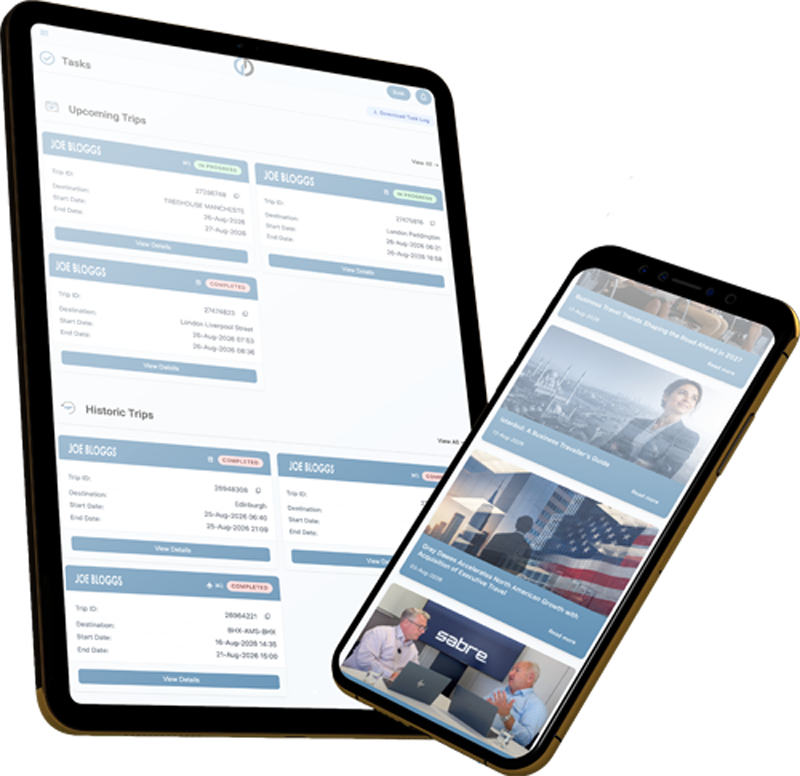
Our single-sign-on PORTAL platform gives you everything you need for your travel, all in one place. Book trips, manage expenses, edit traveler profiles, and more, all with a point and a click.
Training is the Unsung Hero of a Successful Switch
Technology is only as good as the people using it, which is why training is one of the most important and underrated parts of any switch.
Good implementation isn’t a blanket, one-size-fits-all training session. It starts with identifying the key bookers and travelers, since their needs are different. Account managers and operations teams typically run structured boardroom training directly with the client, while day-to-day users get access to on-demand tools like online portals and training libraries so they can learn in a way that fits how they actually work.
“It’s worth being honest here: not everyone embraces change enthusiastically, and that’s fine. The goal of training isn’t to “sell” people on the new system; it’s to make sure genuine issues are resolved quickly and that nobody is left stuck. Often, the biggest source of dissatisfaction isn’t the new service itself, but a lack of exposure to it. Especially those who are carrying preconceived assumptions that a new TMC will inevitably repeat the frustrations of the old one.”
Justin Isaacs, Global Implementation Manager
Every Switch is its own Story…
Switching TMC will always feel like a big decision, one that’s worth taking seriously.
But “big decision” doesn’t have to mean “big disruption”. With early planning, honest communication, hands-on implementation, proper training, and genuine post-launch support, the process is far more manageable than most people expect.
The businesses that get the most out of switching aren’t the ones who avoid asking questions. They’re the ones who ask more of them.