
If you’ve ever looked around the cabin before takeoff and wondered whether your flight is making money, you’re not alone…
To most passengers, an aircraft full of people looks like a guaranteed success. But the economics behind every flight tell a very different story. Airlines operate one of the most complex business models in the world, where millions of pounds of investment, thousands of operational decisions, and razor-thin margins all come together for a single journey.
Understanding how airlines make money, and where they lose it, helps explain everything from ticket prices and baggage fees to schedule changes and aircraft choices.
The ticket is only the beginning…
It’s easy to assume that every passenger pays roughly the same fare, but that’s rarely the case.
On a typical long-haul flight there may be hundreds of passengers, all having paid vastly different prices depending on when they booked, which corporate agreements apply, their level of flexibility, and the cabin they’re travelling in.
For airlines, this is known as yield management; selling the right seat to the right traveller at the right price. The goal isn’t simply to fill every seat. It’s to maximise the total revenue generated by the aircraft.
A flight that departs completely full can actually be less profitable than one with a handful of empty seats, if too many passengers purchased heavily discounted fares.
Premium cabins keep long-haul flying viable
Business travellers play a much bigger role in airline economics than many people realise.
While economy cabins account for the majority of passengers, premium economy and business class generate a disproportionately large share of revenue. On many long-haul routes, premium cabins can contribute well over half of the total ticket income despite representing only a fraction of the physical seats onboard.
That’s one reason why airlines continue investing heavily in business class products, lounges and premium services. Those customers often determine whether an international route is commercially successful.
For organisations managing corporate travel, it also explains why premium demand can influence schedules, aircraft types and route availability.
Airlines don’t just sell flights
Modern airlines have evolved into sophisticated retailers.
Checked baggage, seat selection, onboard food and drink, Wi-Fi, lounge access, upgrades and loyalty programmes all contribute valuable additional income beyond the airfare itself.
Even payment partnerships and frequent flyer programmes have become significant revenue streams.
For travellers, these extras can sometimes feel like unnecessary charges. For airlines, they’re an increasingly important way to improve profitability without dramatically increasing ticket prices.
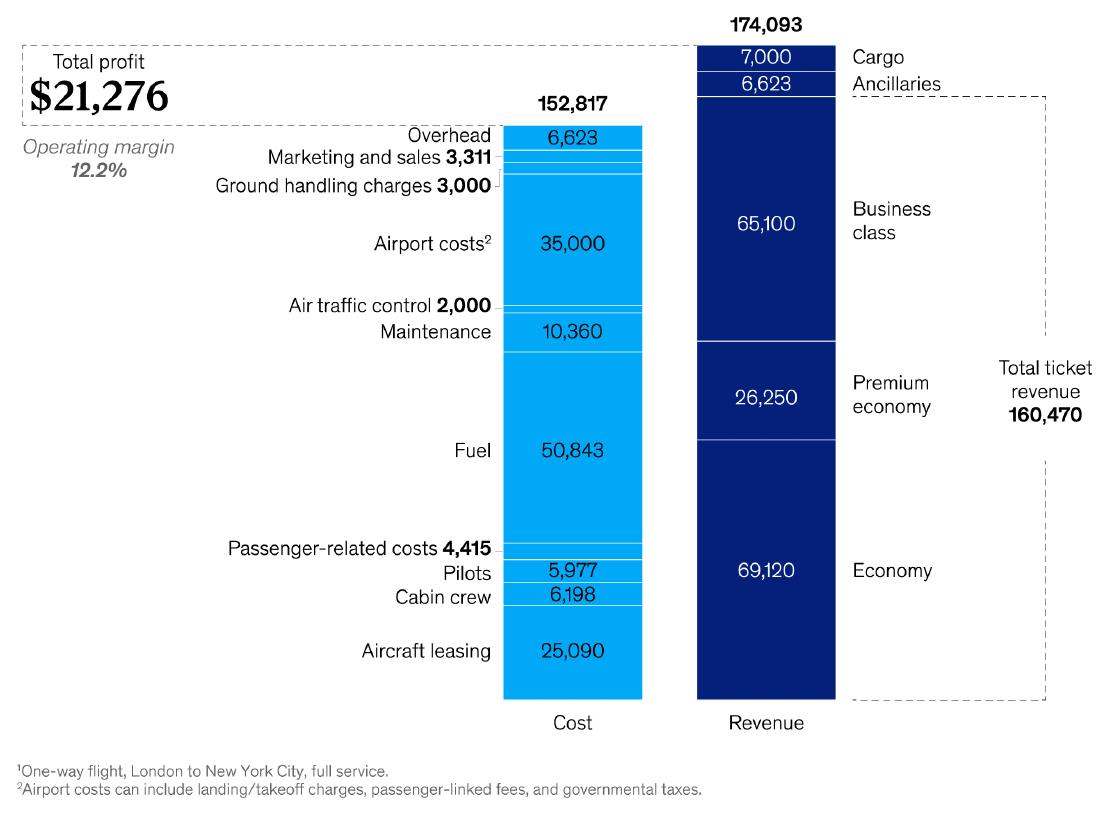
Typical Costs & Profit Breakdown
London to New York
This illustrative example is taken from McKinsey & Company. It shows the typical revenue and costs breakdown of a hypothetical one-way flight from London to New York City – one of Gray Dawes Travel’s most popular routes.
Cargo is the hidden cost beneath your feet
Many passengers don’t realise they’re sharing the aircraft with far more than luggage.
The cargo hold often contains high-value freight, including pharmaceuticals, electronics, automotive components, and e-commerce shipments.
On long-haul routes, cargo revenue can make a meaningful contribution to the economics of a flight. In some cases, the freight carried beneath the cabin can be worth just as much strategically as the passengers sitting above it.
It’s one reason airlines carefully balance passenger demand with freight opportunities when planning networks.
The costs add up remarkably quickly
Running an airline involves far more than fuel.
Every flight generates costs before the aircraft even leaves the gate, including aircraft ownership or leasing, crew salaries, airport charges, maintenance, ground handling, catering, navigation fees, insurance and corporate overheads.
Fuel remains one of the largest operating expenses, but it’s only one piece of a much bigger financial picture.
Unexpected disruption adds another layer of complexity. A weather delay, aircraft change or missed connection doesn’t just inconvenience passengers, it can trigger additional fuel burn, crew costs, airport charges and compensation obligations that quickly erode profitability.
Why full flights don’t always mean healthy profits
Many travellers assume a packed aircraft must be making excellent money.
In reality, airline profitability depends on far more than occupancy.
The mix of passengers matters. Corporate travellers typically generate higher yields than leisure passengers. Direct travellers often provide stronger returns than connecting passengers. The balance of premium versus economy demand can dramatically change the financial outcome of an otherwise identical flight.
Even factors outside an airline’s control – fuel prices, exchange rates, air traffic restrictions or the growing use of Sustainable Aviation Fuel (SAF) – can significantly influence profitability.
That’s why aviation has historically remained one of the world’s lowest-margin industries despite its enormous scale.
💡 Did You Know?
A modern long-haul flight can generate revenue from multiple sources beyond passenger tickets, including cargo, loyalty programmes, ancillary services and commercial partnerships. Yet despite carrying hundreds of passengers, many airlines still operate on average profit margins of only a few percent, leaving little room for disruption or unexpected costs.

Introducing Global Fares Desk
Our Global Fares Desk is the guardian angel of our clients’ bookings. After the trip’s been booked, they keep a watchful eye on fares for any last-minute price changes, passing on additional savings to our clients wherever possible, right up until the day of travel!
It’s a “last line of defence”, designed to complement the outstanding work of our travel consultants and make great bookings even better.
What this means for business travellers
For organisations managing travel programmes, understanding airline economics provides useful context for many of the changes seen across the industry.
Dynamic pricing, evolving fare structures, premium cabin investment, and increasingly sophisticated revenue management aren’t simply commercial tactics; they’re responses to an industry where profitability depends on balancing hundreds of variables on every single flight.
It also reinforces the value of planning ahead, booking within travel policy, and making informed decisions about flexibility and routing. Small choices can have a significant impact on both traveller experience and overall travel spend.
At Gray Dawes Travel, we spend every day helping organisations navigate these changing dynamics. By combining expert guidance, intelligent technology, and strategic supplier relationships, we help businesses secure the best value while keeping travellers moving efficiently… whatever the economics behind the scenes.
Related Articles

Mexico City: A Business Traveller’s Guide
For business travellers, Mexico City is a destination with plenty to offer. Whether it’s attending meetings in Polanco, closing deals in Santa Fe, or enjoying authentic tacos and a tequila after a busy day, the city provides the perfect combination of business and pleasure. In this comprehensive guide for business travellers, we help you navigate Mexico City’s unique business ecosystem, share practical tips for getting around, and highlight our top 3 things to see or do to make your trip unforgettable.

Arrive in Mint® Condition
There’s a lot happening at JetBlue right now. Here’s the latest on their award-winning Mint® product, expanded transatlantic routes and everything they need before their next trip across the Atlantic. JetBlue operates nonstop flights from London Heathrow and London Gatwick to New York JFK and Boston, plus Edinburgh to Boston, with connections to over 100 destinations across the US, Latin America and the Caribbean.

Warsaw: A Business Traveller’s Guide
For business travellers, Warsaw offers plenty of excellent opportunities. Whether you’re attending meetings in the gleaming office towers of Wola or exploring the city’s rich cultural heritage after hours, Warsaw consistently delivers. In this comprehensive guide for business travellers, we help you navigate Warsaw’s unique business ecosystem, share practical tips for getting around, and highlight our top 3 things to see or do to make your trip unforgettable.