
THE TRUE VALUE OF FACE-TO-FACE MEETINGS
the importance of in-person interaction in building meaningful relationshipsDOING BUSINESS ACROSS THE WORLD IS EASIER THAN EVER BEFORE…
Over the past few years (certainly since COVID-19) jumping on a video call or sending an instant message has become par for the course when getting in touch with colleagues. It’s quick, it’s easy, and it can be done anywhere with a half-decent WiFi hotspot or mobile signal.
The digital communication revolution elevated the world of work to new and heady heights. So high, in fact, that it would be tempting to dismiss meeting in-person as an ancient relic of a long-forgotten business society. After all, why drive to an office if I can just meet someone from the comfort of my desk at home?
But it’s not a case of choosing either or. Both have their merits, and both are essential.
In fact, the data suggests that face-to-face meetings are still alive and kicking. According to research from Accor Group, professionals expect to close 37% more deals and increase revenue by 36% through in-person interactions.
In this article, we take a look at the many benefits of face-to-face meetings and how traveling for business can be a key driver for growth.
7 Reasons Why Face-to-Face Meetings Are Important
1. It Drives Revenue Growth
There’s an assumption in modern business that digital meetings are more cost-efficient. That replacing travel with video calls is simply the smarter way to do things. Yet while an organization might save money on petrol or ticket costs, the data suggests a different narrative.
One study of SMEs found that for every $1 invested in business travel, an average of $12 in incremental value was generated. That’s a 12x multiplier, an exceptional investment. Far from being a cost to reduce, face-to-face interaction can turn out to be one of the highest-earning activities a business can fund.
Maybe this shouldn’t come as a surprise. The instinct to show up in person isn’t a relic of the pre-digital age. It’s something far older than that. Long before boardrooms and business cards, humans traveled in close-knit tribes where trust was built through shared experience. That biological wiring hasn’t changed. What’s changed is how easy it’s become to convince ourselves we can fully replicate it through a screen.
2. It Increases Conversion Rates
Closing a deal isn’t just about having a brilliant product or service. Nor does it hinge solely on hard work and persistence. At a certain point, it comes down to one, simple fact. People buy from people.
Not from slide decks. Not from demo videos. Not from a perfectly worded follow-up email. From people. And it’s far easier to be a genuine person when you’re actually in the room. The numbers back this up. Around 40% of prospects convert into customers following an in-person meeting. This is compared to just 16% without face-to-face interaction.
In-person meetings show your commitment. They say, “This matters enough to me that I got on a plane, or drove across town, or rearranged my schedule.” It builds credibility before you’ve said a single word.
3. It Helps Build Stronger Relationships
Nowadays you can reach a prospect in Singapore, follow up with a client in New York, and loop in a colleague in Berlin, all before lunch. In terms of sheer volume and speed, we’ve never been more connected.
But connection and communication aren’t really the same thing. And while modern tech allows us to get in touch with people wherever (and whenever) they are in the world, the true value of communication lies in quality, not quantity. Yes, you might be able to call five different prospects across the country in the space of a few hours, but that doesn’t automatically mean better outcomes.
One meaningful conversation is worth more than ten fleeting chats. And meaning is rooted in real, human interaction.
Face-to-face meetings allow people to read non-verbal cues, engage in more fluid back-and-forth, and respond to the kind of subtle social signals that simply don’t travel through a screen. A shift in the energy of the room. The moment someone leans forward because they’re genuinely interested. These aren’t minor details.
4. It Strengthens Company Culture
Internal meetings matter. Not the routine check-ins and project updates that video calls handle perfectly well, but the deeper work of building a team that wants to work together.
A study found that 37% of professionals believe in-person meetings are crucial for building company culture in a world that has moved closer towards hybrid and remote working. Of course virtual meetings have earned their place. They’re efficient and genuinely effective for a wide range of day-to-day tasks.
But it’s undoubtedly harder to connect with your team in a video call that compresses people into a grid of framed faces and muted microphones. Digital communication tools struggle to replicate the texture of real human interaction – the spontaneous conversation that follows a meeting or the lunch where someone mentions something cool about their weekend. They’re far more powerful than any pre-planned icebreaker.
While face-to-face meetings are important, virtual meetings still have a clear role to play.
They offer a level of convenience that make them ideal for keeping day-to-day operations moving. But the most successful organizations won’t see this as an either/or decision. They combine them to work more intelligently for the best of both worlds.
| Virtual Meetings | Face-to-Face Meetings |
|---|---|
| ✅ Quick updates | ✅ Closing deals |
| ✅ Internal check-ins | ✅ Building relationships |
| ✅ Day-to-day communication | ✅ Strategic collaboration |
| ✅ Routine reporting | ✅ Negotiations |
| ✅ Remote team briefings | ✅ Sensitive conversations |
5. It Helps Reduce Misunderstandings
Slight delays, dropped audio, and those awkward moments where people talk over each other or misread a silence entirely. These are the hallmarks of a video call.
Face-to-face meetings remove any ambiguity. There’s no guessing whether someone’s pause means they’re thinking, disagreeing, or simply frozen on a buffering screen. Conversations happen in real, real-time where you are privy to the full picture.
This is especially valuable when the stakes are high. In negotiations, misreading the room can come across as awkward and could derail a meeting entirely. In sensitive conversations, where tone and empathy matter as much as the message itself, being physically present makes it far easier to ensure you’re truly understood, not just heard.
6. It Helps Boost Productivity
Virtual meetings make it easy to be only half-present. Emails pop up, notifications flash across the screen, and it’s tempting to multitask while someone else is speaking.
Even with the best intentions, focus isn’t always guaranteed, and that has a direct impact on the quality of discussion. In-person meetings cut through that noise. People are more willing to engage, and discussions are more likely to stay on the rails when they’re talking in the same room.
Put simply, when people are fully present, mentally as well as physically, meetings tend to have more purpose, and decisions can be made faster.
7. It Fosters Better Creative Ideas
Innovation doesn’t happen in a vacuum. It’s driven by a person’s creative energy and the kind of spontaneous talk that only occur when everyone is in a room together.
Virtual meetings have their place, but they are, by their nature, more structured. That makes them perfect for quick updates or check-ins, but not for truly original thinking.
The conversation that starts while people are still finding their seats in a boardroom. The offhand comment after a meeting wraps up. The ideas that surface over an oat-milk latte that wouldn’t have come up in any scheduled call. These moments are often where the most valuable thinking takes place – an enviornment where half-formed ideas are free to float until they find somewhere to take root and flourish.
That kind of organic creativity is almost impossible to replicate through a screen. And yet it’s precisely what fuels true, outside-the-box, innovation.
Face-to-Face Meetings Are Still as Valuable as Ever
Despite the rise of digital communication, face-to-face meetings remain a critical driver of business success. The data is unambiguous: professionals expect to close 37% more deals and generate 36% more revenue through in-person engagement.
But the real argument for business travel isn’t found in statistics. It’s found in the handshake that seals a partnership, the dinner conversation that turns a prospect into a long-term client, the meeting that unlocks a problem a team had been emailing around for weeks.
In an era defined by digital communication tools, showing up in person has become a competitive differentiator. The organizations that recognize this and invest accordingly, will be front of the queue when it comes to building the kind of relationships that last the test of time.
Related Articles

Mexico City: A Business Traveller’s Guide
For business travellers, Mexico City is a destination with plenty to offer. Whether it’s attending meetings in Polanco, closing deals in Santa Fe, or enjoying authentic tacos and a tequila after a busy day, the city provides the perfect combination of business and pleasure. In this comprehensive guide for business travellers, we help you navigate Mexico City’s unique business ecosystem, share practical tips for getting around, and highlight our top 3 things to see or do to make your trip unforgettable.

The Economics of a Flight
To most passengers, an aircraft full of people looks like a guaranteed success. But the economics behind every flight tell a very different story. Airlines operate one of the most complex business models in the world, where millions of pounds of investment, thousands of operational decisions, and razor-thin margins all come together for a single journey.
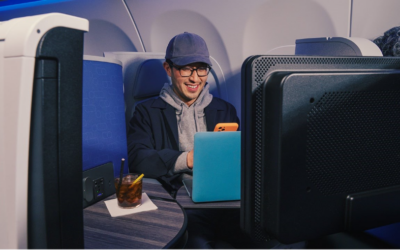
Arrive in Mint® Condition
There’s a lot happening at JetBlue right now. Here’s the latest on their award-winning Mint® product, expanded transatlantic routes and everything they need before their next trip across the Atlantic. JetBlue operates nonstop flights from London Heathrow and London Gatwick to New York JFK and Boston, plus Edinburgh to Boston, with connections to over 100 destinations across the US, Latin America and the Caribbean.